
Franklin Released Mugshot Records
A booking photograph, often called a mugshot, is the image made during jail identification and processing. The FCSO Identification Bureau says its technicians electronically capture, search, and store photographs for people processed through both county jails. That supports the existence of an agency photo record even when the image is no longer visible on the live site.
The photo proves that an image was tied to a booking. It does not prove guilt, the final case outcome, the date of release, or present custody. A current roster photo can disappear when the person is no longer returned by a current-only search. The underlying record follows applicable retention rules, legal holds, public-record exemptions, and court orders rather than the shorter life of a web result.
Ohio’s Public Records Act supplies the request framework. Access can still be limited by sealed or expunged matters, juvenile confidentiality, victim or witness protections, security concerns, medical information, personal identifiers, and other law. A custodian can redact protected parts while considering release of nonexempt material.
Franklin Released Mugshot Search Channels
Each channel has a different scope. The FCSO roster concerns current county inmates. A Sheriff records response can reach an older county booking. ODRC covers state prisoners and some released or supervised people. A court record explains the legal case, but it may not contain the booking image. Secondary publication is less reliable than the originating copy.
| Channel | Has a photo? | How to access it |
|---|---|---|
| FCSO live booking record | May show a current booking photograph and photo date | Search the official current-inmate interface |
| Franklin County Sheriff OH app | No official proof of a released-photo archive | Use as mobile access to current jail-roster information only |
| FCSO public-record request | Can seek the stored image for a named booking | Specify person, date, number, and “booking photograph associated with that booking” |
| ODRC Offender Search | Detail pages commonly include an offender photo | Use only if the person entered Ohio state custody |
| VINE | Not established here as the historical photo source | Use for custody events and alerts, then confirm with the custodian |
| News or secondary publication | May carry an old image | Verify against the agency record and current court disposition |
A person who bonded out of Karnes and never entered ODRC will not gain a state correctional photo merely because the case began in Franklin County. Conversely, an ODRC image is a state offender image and may differ from the Sheriff photograph taken at arrest. Keep the source and booking date attached to each image.
Note: A matching face alone cannot safely distinguish people with similar names or establish a release event.
Franklin Sheriff Mugshot Roster Limits
The official FCSO interface is a current-inmate search. Its booking-detail schema has a photograph area, photo date, status, assigned location, scheduled release date, identifying details, charges, cases, bond fields, and court dates. Fields can be blank, and the presence of a scheduled date does not mean that release occurred.
The official booking-detail capture shows how the photograph sits beside live custody and case data.
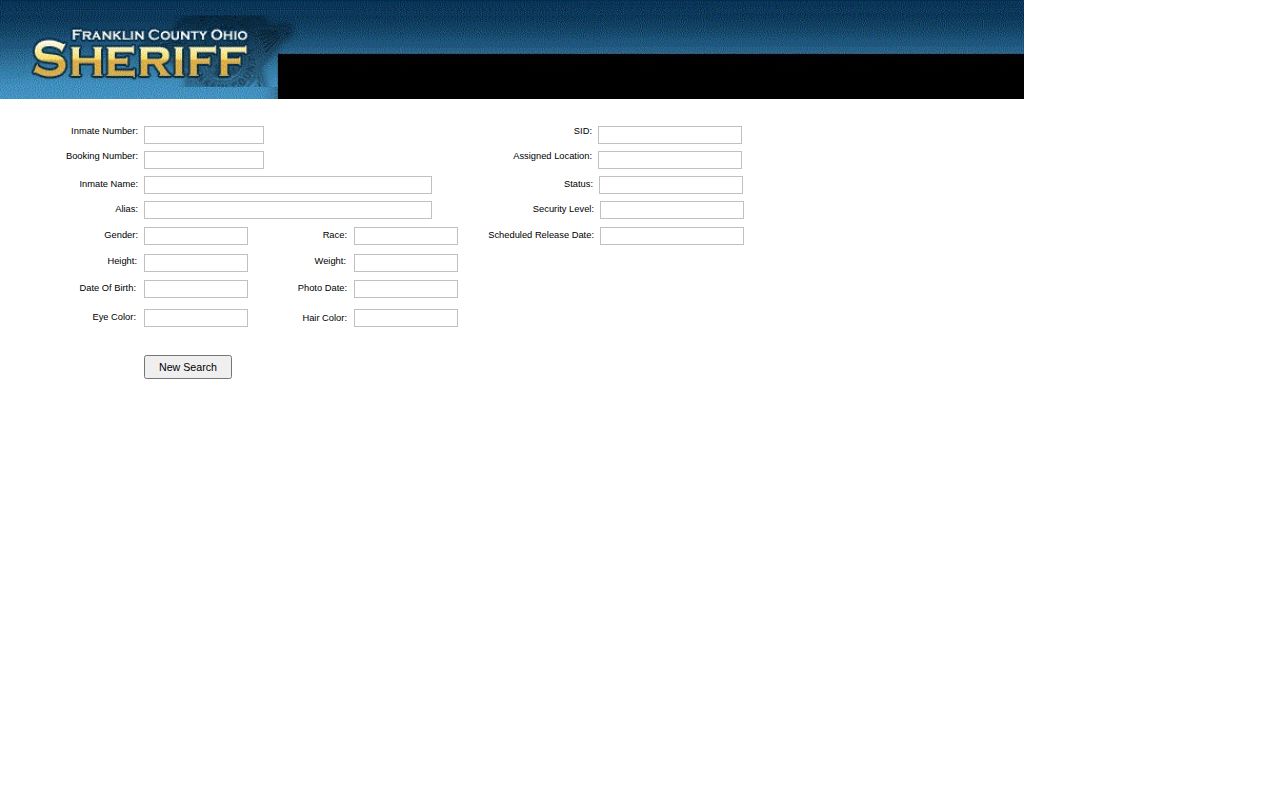
The image is useful for understanding the record layout, but a current booking example must never be presented as a released-person gallery.
Request Franklin County Booking Photos
A focused request is the strongest route to an older county-jail image. The FCSO Public Records channel accepts requests for existing records. Identify the booking rather than asking staff to research an open-ended photo history. Request electronic delivery to control cost, and ask for a legal reason if all or part of the image is withheld.
- Gather the full legal name, date of birth or Sheriff ID, booking number, and approximate booking date. Include aliases only when they help identify the same person.
- Ask for the “booking photograph associated with that booking.” If release proof is also needed, separately request the booking face sheet and actual release or movement date and time.
- Send the narrow request through FCSO Public Records. The listed records line is 614-525-6096, and the Identification Bureau line is 614-525-3835.
- Ask for electronic copies and the applicable retention schedule. No fixed FCSO photo fee or universal response deadline was found.
- If content is redacted or withheld, ask for the legal basis and any reasonably separable nonexempt part.
Ohio law permits actual copy and delivery costs. ORC 149.43 calls for prompt inspection and copies within a reasonable period, which depends on scope, storage, review, and redaction. It does not create one fixed number of days for every photo request. The Franklin County release-record instructions show how to ask for the associated custody movement without assuming the person returned to the community.
Franklin Mugshots in Ohio Records
The ODRC Offender Search can return people who are incarcerated, released, judicially released, under APA supervision, or listed as Violators at Large. Detail pages commonly show a state offender photograph along with the offender number, sentence, committing county, docket, expected or eligibility date, and release or supervision data.
Use the ODRC image only with the state record. Confirm identity through the offender number, Franklin commitment, docket, offense, and sentence. The photo is not the county booking photograph unless the agencies specifically establish that. ODRC does not cover a person who only spent time in the Franklin County jail and then left under bond, time served, dismissal, or another local outcome.
For a formal state copy, the offender detail directs questions to ODRC Central Records, P.O. Box 430, Columbus, Ohio 43216. Identify the offender number and request the public photograph or admission and release history needed. State records remain subject to lawful redaction and correction procedures.
Franklin Sheriff Mugshot App Limits
Franklin County has a mobile app called “Franklin County Sheriff OH.” Its listing and local launch coverage say it offers jail-roster lookup. No authoritative source reviewed establishes a recent-release filter, former-inmate archive, or released-person photo collection in the app. It should be treated as another route to current jail information, not as proof that a historical mugshot remains available.
The app is distinct from GTL or ViaPath visitation tools linked by the Sheriff. Those products schedule or support visits and are not release feeds or photo archives. If a current app result displays useful identifying data, capture the case or booking number and return to FCSO for the official stored photo.
The absence of an app archive is a Franklin-specific fact. It should not be filled with an unofficial gallery. The Franklin County 24-hour release route likewise begins with current custody and official fallback channels because no Sheriff daily release feed was found.
Note: App functions can change, so rely on the custodian record when an image must be authenticated.
Franklin Mugshots in News
A local news report or another secondary publisher may preserve an old image. Such a copy can be stale, cropped, mislabeled, or disconnected from the final disposition. News releases are event-specific. They are not a complete list of Franklin County releases, and a published arrest photo does not show that custody ended.
Use a secondary image as a lead, not the final record. Match the full name, booking or case number, date, and originating agency. Then check the Municipal or Common Pleas docket for the later court outcome and ask FCSO for the booking photograph if an agency copy matters. No commercial mugshot publisher or removal service is linked or endorsed.
Franklin Mugshot Sealing and Removal
FCSO’s Identification Bureau expressly handles sealing and expungement work. That makes it the proper local correction channel when an official booking image remains accessible after a court order. A sealing order restricts public access. Expungement has a statutory meaning and effect. Eligibility, timing, and relief vary by offense and disposition under Ohio Revised Code Chapter 2953.
A missing public result does not prove that a case never existed, that relief was granted, or that a photo must be deleted everywhere. Start with the journalized court order. Give a copy and the case and booking identifiers to the government office responsible for the record. A secondary publisher should be told about the same order through its stated correction channel, but no paid removal service is needed to contact the official custodian.
Ohio’s distinctive mugshot statute is ORC 2927.22. It defines booking photographs and limits specified payment-related conduct by criminal-record-information publishers, including negligent solicitation or acceptance of payment from the subject to remove, correct, modify, or refrain from publishing covered information. It supplies criminal and civil consequences. It is an anti-pay-to-remove rule, not a blanket ban on all publication or a general deletion right.
Government access still turns on ORC 149.43, exemptions, and court orders. The direct FCSO route is backed by the Bureau’s stated work of capturing and storing photographs, so it remains the sound old-photo path when no released-photo archive exists.