
Franklin Projected Versus Actual Release
A projected or scheduled date is a forecast. An actual release is an executed custody event. The Franklin County Sheriff’s booking schema includes “Scheduled Release Date,” but that field may be blank or may change. A releasing movement or release authorization is stronger proof that someone left Karnes or FCCC II. The controlling court docket explains the legal authority, while the Sheriff record supplies the physical departure time.
ODRC uses the combined label “Expected Release Date/Parole Eligibility Date.” One half may be a computed date for a definite term. The other may mark only the first date when a person becomes eligible for parole review. For an indefinite or life sentence, eligibility does not mean parole was granted. Compare the date with status, supervision start, parole or release detail, and any Board result.
A pretrial detainee has no sentence-based end date. Bond, recognizance, dismissal, a holder, or a later order may control release. A transfer to ODRC, another county, federal custody, or a hospital is not a community release.
Find Franklin County Projected Release Dates
Start with the agency that has custody. FCSO covers the two active county jails. ODRC covers a person conveyed to an Ohio prison. A Common Pleas or Municipal Court record supplies the sentence, bond, credit, and later orders. This avoids applying a state-prison formula to a local jail term.
- Search the FCSO public inmate system when the person was last held at Karnes or FCCC II. Read status, assigned location, case number, and any scheduled date.
- Open the correct court docket. Use Common Pleas Case Information Online for a felony case or the Municipal Court search for its cases.
- If the docket shows conveyance or commitment to state prison, switch to the ODRC Offender Search. Begin with a last name or use the offender number.
- Match the person by number, committing county, docket, offense, admission, and sentence. Copy the exact status and exact release-date label.
- Check for jail-time credit, consecutive terms, court changes, holds, APA supervision, and parole results. Ask the responsible records office to reconcile any conflict.
- Confirm an actual exit through the custodian record. The broader Franklin County release-record process identifies the precise Sheriff documents to request.
Less search data often works better in ODRC. A male number generally starts with A or R and six digits. A female number uses W and six digits, with a leading zero when needed. Franklin as county of commitment helps narrow a match, but it is not the person’s present institution or residence.
Note: Save the field label and lookup date, not just the number shown beside it.
Franklin State Release Date Fields
The ODRC detail record can include admission and sentence facts, jail-time credit, aggregate or net sentence, offenses, committing county and docket, hearing data, the combined expected or eligibility date, POA/PRD date, supervision dates, APA office, and release detail. Some records also display a photograph. The image helps with identity but does not prove the release date.
The ODRC definitions screen explains the expected-date and Board-date terms. Its exact layout shows why a reader must preserve the agency’s wording.
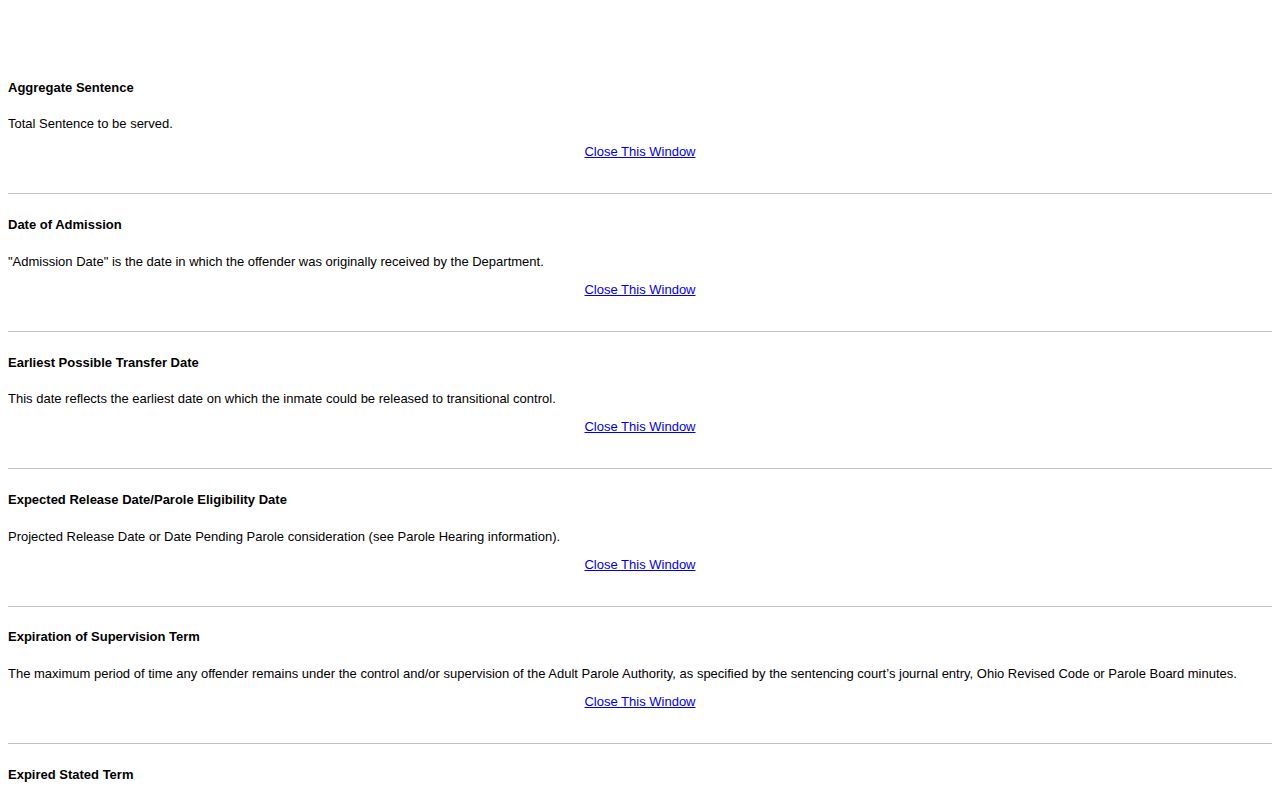
The captured definitions separate a prospective release calculation from parole eligibility. That distinction is central when checking a Franklin County commitment.
| ODRC field | What it can establish | What it cannot establish alone |
|---|---|---|
| Status | Current recorded relationship to ODRC | The exact gate time |
| Expected Release Date/Parole Eligibility Date | A calculated date or eligibility point | That parole was granted or release occurred |
| POA/PRD Date | A Board-related on-or-after or projected date | An unconditional release |
| Supervision start/end | A recorded APA period | The county-jail movement |
| Release detail | The state’s release type or event | Unrelated local or federal custody |
Franklin Release Date Calculation
A state calculation begins with the journal entry. Staff apply the effective sentence date, mandatory parts, concurrent or consecutive structure, and confinement credit under ORC 2967.191. Concurrent terms run at the same time, while consecutive terms run one after another. ODRC then applies eligible earned credit and later legal or disciplinary changes.
For Franklin County jail time, do not mechanically apply ODRC rules. Begin with the Municipal or Common Pleas judgment and the listed jail-time credit. Then compare the Sheriff’s scheduled field with the actual release or movement entry. A local term can end while another agency hold keeps the person in custody.
ODRC Central Records is the proper source for a state calculation sheet or reconciliation. The offender detail directs mail to P.O. Box 430, Columbus, Ohio 43216. A focused request should provide the offender number, docket, and the exact field in dispute.
Ohio Credit for Franklin Releases
Current earned-credit law appears in ORC 2967.194. Under the framework effective April 4, 2024, an eligible person can provisionally earn one or five days for a completed month of approved productive participation, depending on the statutory category. Education, vocational work, prison industries, substance-use treatment, and other approved programs can qualify when their standards are met. ODRC may deny or withdraw provisional credit after rule violations.
The ordinary aggregate cap is 15 percent of the stated prison term, subject to the statute’s details and exclusions. That cap leads to the common “serve 85 percent” shorthand. It is not a promise that each Ohio prisoner leaves after exactly 85 percent. Mandatory terms and specified serious offenses may be excluded or non-reducible, and an eligible person may earn less than the maximum. Older periods may fall under former ORC 2967.193.
Judicial release under ORC 2929.20 is a separate court process, not automatic good time. Life and parole-eligible terms also require sentence-specific review under ORC 2967.13. Eligibility opens review but does not compel release.
Note: The maximum possible credit is not the same as credit actually earned and posted.
Why Franklin Release Dates Change
A date can move before release because the sentence record is not static. Some changes advance a date. Others delay it or change the destination. The reason should be traced to the court, ODRC, APA, or holding agency rather than guessed from an updated number.
| Factor | Possible effect | Best confirming source |
|---|---|---|
| Jail-time or confinement credit | Adjusts time already served | Journal entry and ODRC calculation |
| Earned credit | May reduce an eligible term | ODRC sentence computation |
| Rule violation | Credit may be denied or withdrawn | ODRC record |
| Corrected order or new sentence | Changes the sentence structure | Journalized court entry |
| Detainer or holder | Prevents community release or changes destination | Holding and receiving agencies |
| Parole action | Sets, continues, or withdraws a conditional date | Board result and official minutes |
| Release-plan issue | Can delay a conditional departure | ODRC or APA |
A detainer is another agency’s request to hold or transfer the person. Meeting the Franklin County term does not cancel it. Likewise, a favorable Board outcome can still be reviewed before physical release if new charges, misconduct, placement issues, or unmet conditions arise.
Sentence structure can create changes that look like calculation errors. A later case may add a consecutive term. An appeal or corrected entry may alter credit or the effective date. ODRC’s public notice also warns that sentence information may not be a complete list. Compare every listed docket with the journal entries, then seek a calculation sheet when the numbers cannot be reconciled from public fields.
Franklin Release Dates With Similar Names
Ohio has two labels that look much more alike than they are. “Expected Release Date/Parole Eligibility Date” appears on the offender record and may mark either a calculated date or a first review point. A formal PRD is a narrower Ohio Parole Board outcome recorded in official minutes under OAC 5120:1-1-10.
The Board Handbook describes the PRD outcome as relatively rare. It can set a date up to a year ahead, such as when programming must be completed. A POA is a parole-on-or-after date. Both remain conditional until release occurs, and both can be reviewed. Preserve the full label, result, and source instead of calling each one a fixed release date.
A monthly hearing result also needs context. The first hearing may occur at a statutory eligibility point. A continued hearing means release was not granted then and a later review was set. A Full Board hearing can follow a proposed parole in qualifying circumstances. Official minutes or a written decision resolve details that a short online result cannot show.
The manifest capture of an ODRC representative record shows the sentence and expected-date layout. It is an interface example, not a Franklin County case.
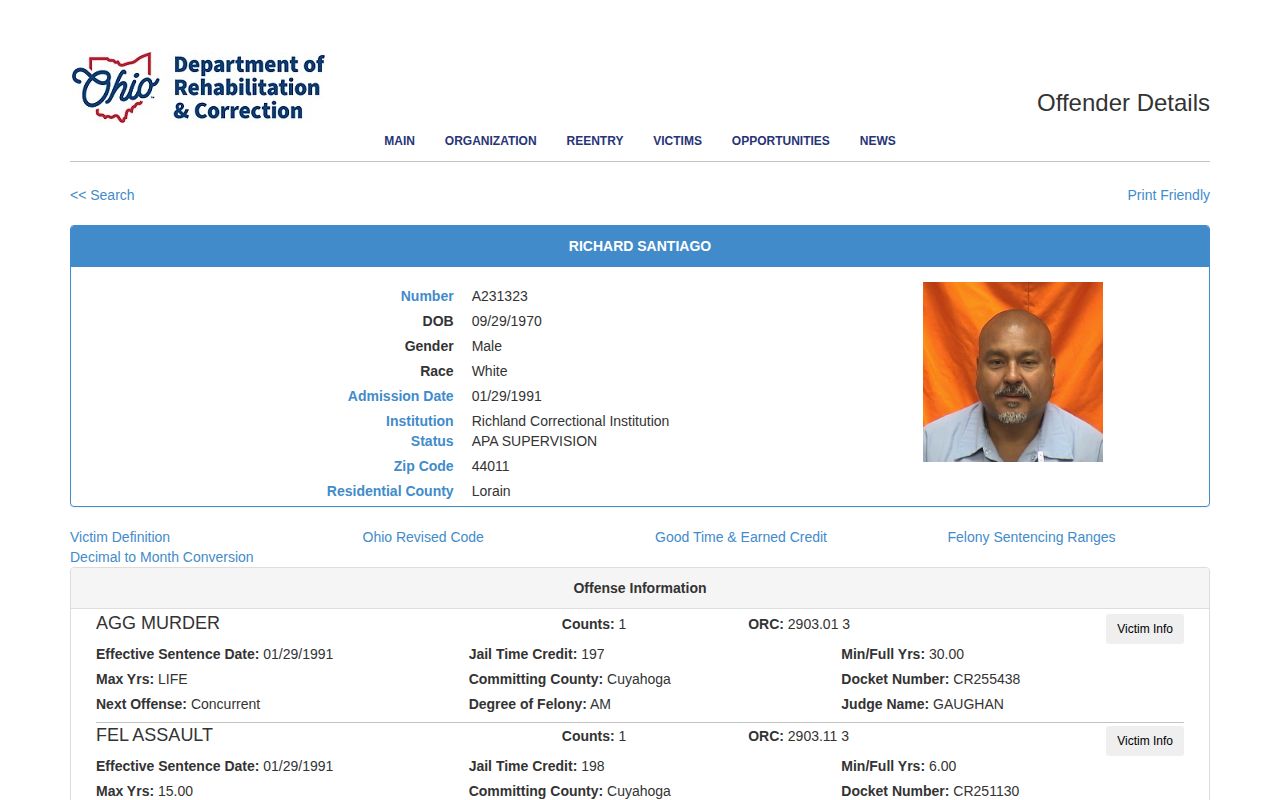
The record view demonstrates why the sentence, commitment county, status, and date label must be read together.
Confirm Franklin County Actual Release
For county custody, request the booking face sheet and releasing movement from FCSO. Ask for the actual release or transfer date and time, movement type, authority, destination or receiving agency if public, and holds disposition. For state custody, compare ODRC status with release detail and supervision start. A certified court order proves the judge’s act but may not show when processing ended.
For a recent county event, the inmate-information line can distinguish continued custody from a transfer while records processing is underway. Give the full legal name, date of birth, booking number when known, and approximate admission date. Ask whether the scheduled field was executed as community release or replaced by another movement. Staff may withhold protected details, but a precise question reduces the risk of treating a roster disappearance as release.
VINE can provide a pending custody alert through telephone, email, SMS, TTY, or mobile access. Registration is an alert channel, not a release certificate. The Franklin County VINELink check gives the specific-person registration path. Always confirm an alert with FCSO, ODRC, or the court responsible for the case.