
Franklin County Release Meanings
“Released” should describe the end of a specific agency’s custody, not just a name disappearing from a screen. A person may leave the James A. Karnes Corrections Center or Franklin County Corrections Center II after posting bond, receiving recognizance, completing a local term, getting a dismissal, or receiving another court order. Those events can return the person to the community. Yet a departure can also be a conveyance to the Ohio Department of Rehabilitation and Correction, another county, a hospital, the U.S. Marshals Service, or immigration custody. That is a transfer, even though the Franklin County jail no longer holds the person.
A sound Franklin County release check answers four points: who held the person, what authority caused the exit, when physical custody ended, and what custody or supervision followed. The court journal states what a judge ordered. The Sheriff’s releasing movement records when jail staff carried it out. ODRC controls the state-prison and Adult Parole Authority record. VINE reports events from participating agencies, but it is not a certified record. Keeping those roles separate prevents a roster change from becoming an unsupported release claim.
- Discharge
- The end of the custody or supervision described by that agency’s record.
- Time served
- A sentence satisfied by time already spent in custody, subject to the court entry and release processing.
- Parole
- Conditional release from a parole-eligible prison term under state authority.
- Probation
- Court-ordered community supervision, which can exist without a state-prison term.
Franklin County Release Types
The label on the actual record matters. “Bond” means the criminal case normally remains open while the person is out of jail. “Time served” addresses the custodial part of a sentence, but fines, reporting duties, or another case can remain. A dismissal or acquittal can end the case that produced the booking. Community control places the person under court supervision. None of those events should be confused with a state conveyance or another-agency hold.
| Exit type | What it means | Best next source |
|---|---|---|
| Cash, surety, or recognizance | Release to the community while the case may continue | Court bond entry and Sheriff release movement |
| Time served or sentence end | Local jail custody is complete | Sentencing entry and actual release record |
| Dismissal or acquittal | The listed charge or case ended without conviction | Municipal or Common Pleas docket |
| Community control | Custody ends while court supervision continues | Sentencing court and probation record |
| ODRC conveyance | County custody changes to Ohio state custody | ODRC Offender Search |
| Federal, ICE, or other hold | A different authority may continue custody | Receiving agency and court record |
A death, restricted treatment placement, hospital move, or transfer to another jail can also remove a person from the live Franklin County roster. Ask for the destination or receiving authority when that field is recorded and public. Do not assume that the same exit code applies to every booking.
Bond and Franklin Release Proof
Franklin County divides bond authority and physical release between two systems. FCSO directs bond questions to the Clerk, so the case number on a jail result should be carried into the Municipal or Common Pleas docket. The court entry can show the bond terms and legal authority for release. It does not prove the time jail staff finished processing the departure.
The Sheriff’s movement or releasing record supplies that operational fact. Pairing it with the court order avoids two common errors: treating a posted bond as proof that the person already left, or treating a roster disappearance as proof that bond caused the exit. If another hold remained, local bond could be satisfied while custody continued elsewhere.
Franklin County Release Record Fields
The booking face sheet anchors identity. It may include the full name, aliases, date of birth, Sheriff identification number, inmate number, booking number, booking date, charges, case numbers, photograph, assigned location, and status. Release-side data answers a different question. It may show the actual date and time, an exit or movement code, the authority that approved the action, and a transfer destination. Availability varies, and lawful redactions may apply.
| Field | What it can establish |
|---|---|
| Booking or SID number | Links the request to the correct Franklin County admission |
| Actual release date and time | When jail staff recorded the physical departure |
| Release or movement type | Whether the exit was bond, sentence completion, court order, or transfer |
| Releasing authority | The order, court, or official basis used to process the exit |
| Destination or receiving agency | Whether another custodian took control, if maintained and public |
| Hold disposition | Whether a detainer was cleared or executed |
| Booking photograph | An identity aid tied to that booking, not proof of release |
A scheduled release date is prospective. It can change. A court-ordered date supplies legal authority, while a jail “out” movement records execution. An ODRC supervision start can mark release from prison to APA supervision, and sentence expiration can occur later. Quote the source’s exact date label instead of converting each field into one generic release date.
Request Franklin County Release Records
The Franklin County Sheriff public-records channel is the direct route to a historical county-jail exit. A narrow request is easier to identify and review. It should not ask staff to create an explanation. Instead, name existing booking, custody-movement, releasing, authorization, photograph, and retention records. Ohio generally does not require a requester to explain a purpose, but the request must identify the desired records with reasonable clarity.
- Identify the full legal name, date of birth, booking or Sheriff number, and approximate admission date.
- Give a date range and ask for booking and actual release or movement dates and times.
- Request the release or movement type, releasing authority, public destination, holds disposition, and booking photograph.
- Ask for electronic copies, the applicable retention schedule, and a cost estimate before work that creates a charge.
- If material is withheld, request the legal basis and all reasonably separable public portions.
373 South High Street, Floor 2B
Columbus, OH 43215
614-525-6096
FCSOPublicRecords@franklincountyohio.gov
No fixed Sheriff release-record fee or universal response deadline was found. Ohio Revised Code section 149.43 allows actual copy and certain delivery costs and calls for prompt inspection and copies within a reasonable period. Scope, storage, legal review, and redaction can affect timing. Online disappearance does not set retention. The office’s approved schedule and legal holds govern the underlying record.
Franklin County Release Record Limits
Ohio’s Public Records Act supplies the request and copy framework, but it does not make every field open. Medical records, security-sensitive details, victim or witness information, juvenile material, protected identifiers, sealed matters, and information barred by another law can be withheld or redacted. A denial should state its legal authority. Redaction counts as a denial of the removed part, while the office should still consider whether nonexempt portions can be released.
Sealing and expungement under Ohio Revised Code Chapter 2953 depend on the disposition, offense, eligibility rules, and court order. There is no single waiting period for every Franklin County case. A blank public search does not prove that no case existed or establish a release date. Questions about jail identification data that did not update after an order belong with FCSO Identification or Public Records. Juvenile records use separate access rules.
Important: Online visibility is not a retention schedule. Request the schedule when the age or continued existence of a Franklin County release record matters.
Find Franklin County Released Inmates
The strongest search path follows custody from one agency to the next. Start with the official FCSO system. A current match means the person remains in one of the two active Sheriff centers. A missing match is only a branch point because release, transfer, a different spelling, data lag, or another placement can all explain it. Record the time searched and all identifiers before moving to the court and state systems.
- Search the FCSO current-inmate interface by last and first name, then preserve the booking and case numbers on a match.
- Check both Franklin County court systems when case level is uncertain. Municipal Court covers misdemeanors and preliminary felony steps; indicted felonies proceed in Common Pleas.
- Call inmate information at 614-525-3368 for a recent event and ask staff to distinguish community release from transfer.
- If the docket shows an ODRC conveyance, search Ohio’s state record by name or offender number and read the exact status and date labels.
- Use BOP or ICE only when the facts point to federal or immigration custody, then request the originating agency’s record for documentary proof.
The Franklin County 24-hour release path explains the same-day fallback in depth. For a past event, pair the court’s authority with the Sheriff’s operational release or movement entry. VINE may corroborate an agency event, but it should not replace those records.
Ohio Search for Franklin Releases
The ODRC Offender Search covers people incarcerated in Ohio prisons, judicially released, released from state custody, supervised by APA, or listed as Violators at Large. It does not cover someone who simply bonded out of a Franklin County jail and never entered state custody. Search with less data first. A last name can find variants that an overfilled form misses; first name, county of commitment, or offender number can then narrow the results.
| Search field | Use | Caution |
|---|---|---|
| Last and first name | Broad identity search | Confirm with number, docket, and offense |
| Offender number | Strong state identifier | Ohio letter prefixes and digits must match |
| County of commitment | Narrows to a Franklin sentence | Not the same as current home or prison |
| Status | Includes Incarcerated, Released, APA Supervision, and Violators at Large | Quote the full displayed status |
| Next hearing month | Finds a scheduled parole-review month | A hearing date is not a release date |
The matching detail should be reconciled by name, ODRC number, committing county, docket, offense, and admission data. Copy the exact “Expected Release Date/Parole Eligibility Date,” POA/PRD, supervision, and release-detail labels. Eligibility does not mean actual release. The official Ohio status-filter screen shows the categories used in this search.
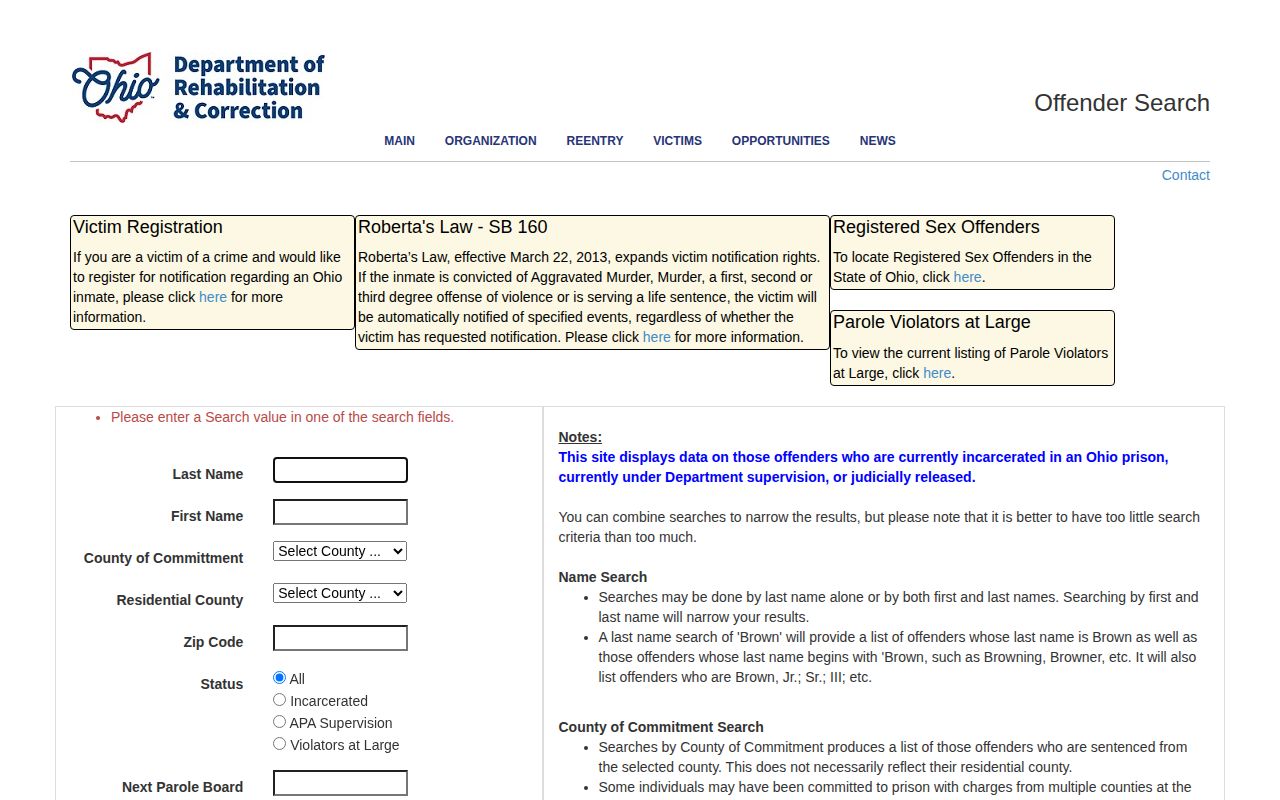
The image illustrates why a state-prison search can continue after physical release: Released and APA Supervision are distinct choices beside current incarceration.
Franklin County Recent Release Checks
Franklin County does not publish an official 24-hour or 72-hour released-inmate list in the Sheriff sources reviewed. The FCSO Booking Find interface is a current-custody search. It advertises current inmates, charges, case numbers, visitation location, and court dates. The official material does not promise a former-booking archive or state how long a record remains visible after release.
The booking detail can show a photo, assigned location, status, a scheduled release date, cases, charges, bond, and court information. Individual fields may be blank. Bond questions belong with the Clerk, as the Sheriff itself warns. “Real time” in an older Sheriff announcement does not guarantee instant processing, nor does it convert a missing name into proof of release.
Q: Why did a Franklin County inmate leave the roster?
A community release is one possibility. So are an internal transfer, an ODRC conveyance, another-agency hold, hospital movement, or a data issue. Confirm the event with the court and releasing record.
Two Courts Track Franklin Releases
Franklin County has a sequential court trail. The Municipal Court case search holds misdemeanor, traffic, and preliminary felony activity. An indicted or bound-over felony moves to the Common Pleas case system. A terminated Municipal entry can therefore be a handoff, not a release. Search both systems before drawing a conclusion.
Look near the last custody date for bond, recognizance, dismissal, sentencing, time served, jail credit, conveyance, community control, judicial release, termination, warrant, or sealing entries. A docket shows the judge’s act. It may not show when jail staff finished release processing. Use the case number to request the Sheriff movement that establishes the physical exit.
The official Common Pleas interface can help trace a felony disposition back to its journal entry.
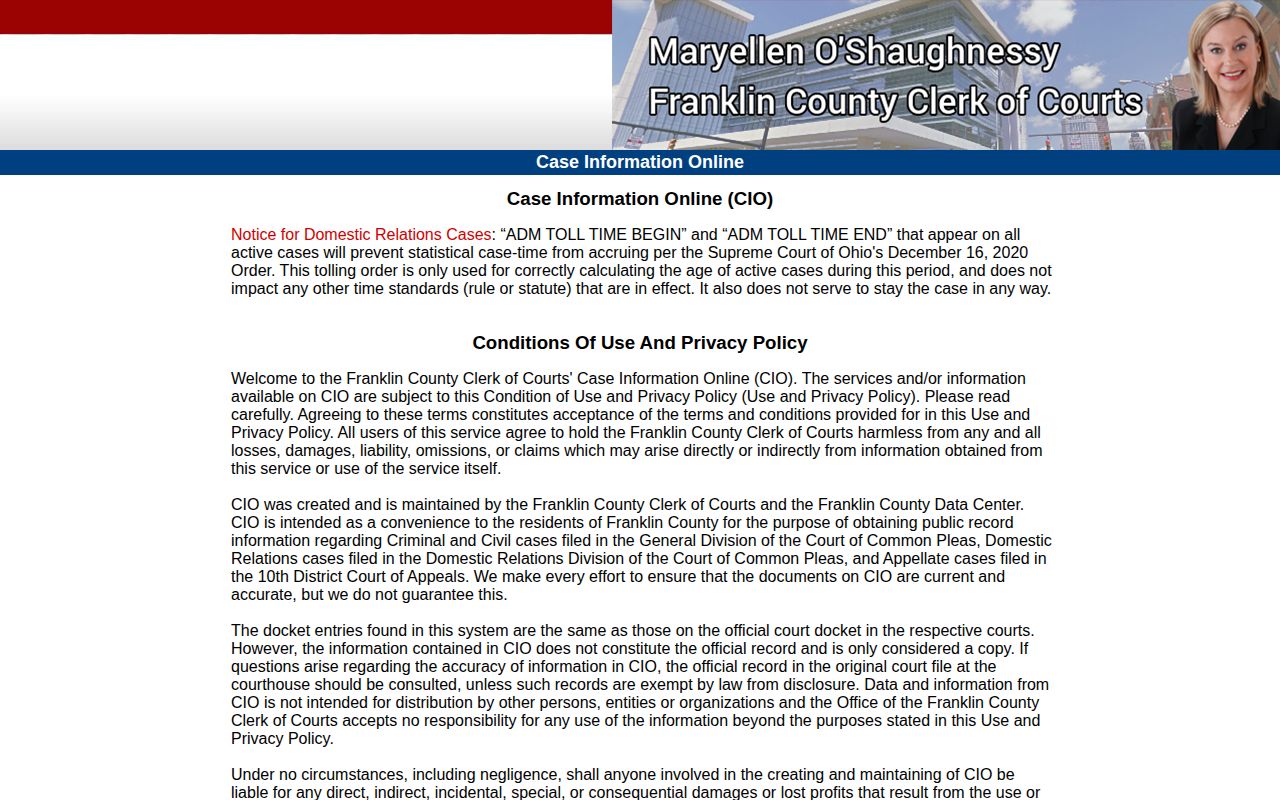
This court screen preserves the judicial trail that a short-lived current-jail result cannot supply.
Franklin Release Supervision Records
Physical release may begin another legal status. ODRC’s Adult Parole Authority supervises qualifying people after Ohio prison custody. Common Pleas and Municipal Court probation departments manage their own community-control populations. Pretrial supervision, probation, post-release control, judicial release, and parole are different. The sentencing record determines which office and terms apply.
For APA, search all ODRC statuses or choose APA Supervision, then read the supervision start, expiration, and listed office. A Violator at Large entry means an unresolved supervision issue, not successful discharge. For county probation, review the sentence, conditions, later violation or modification entries, and termination record in the correct court. The full Franklin County parole and probation page separates these routes.
Help After Franklin County Release
Rapid Resource Centers operate at the Fisher Road and Jackson Pike jail campuses. They connect people returning to the community with peer help, health and behavioral-health services, identification documents, food, emergency shelter, and transportation. Franklin County’s Pathways program adds case management and recovery or reentry support before and after release. These are transition services, not inmate locators.
The Rapid Resource Centers and Pathways help with the transition after custody. They do not certify a Franklin County release, change the jail record, or replace an agency search.
IDs After Franklin County Release
Rapid Resource Centers specifically help people pursue a birth certificate, driver-license reinstatement, and transportation connections after a Franklin County release. Those practical needs can affect work with service agencies and the trip home, but they remain separate from the legal custody record.
An error in the person’s booking identity, photograph, status, or release history goes to FCSO Identification or Public Records. A state-prison error belongs with ODRC Central Records. Resource-center staff can help someone navigate services, but only the records custodian can correct an official entry.
Franklin Release Alerts and Federal Records
Ohio VINE offers custody information and phone, email, SMS, mobile, and TTY notifications. Select Ohio, find the specific person and reporting facility, and read the event wording. County notices can include general release, transfer, escape, or death. A VINE event should be confirmed with the custodian because it does not rule out another hold or later supervision.
Federal custody uses different systems. The BOP Inmate Locator covers federal inmates from 1982 onward and may display “Released” or “Not in BOP Custody” with a date. That means the person left BOP custody, not necessarily every form of custody or federal supervision. ICE’s locator can include current detainees and people released from ICE custody within its stated recent window, but a missing result is not proof. USMS has no county-style historical release list.
The BOP screen shows the identity and location fields used for a federal check.
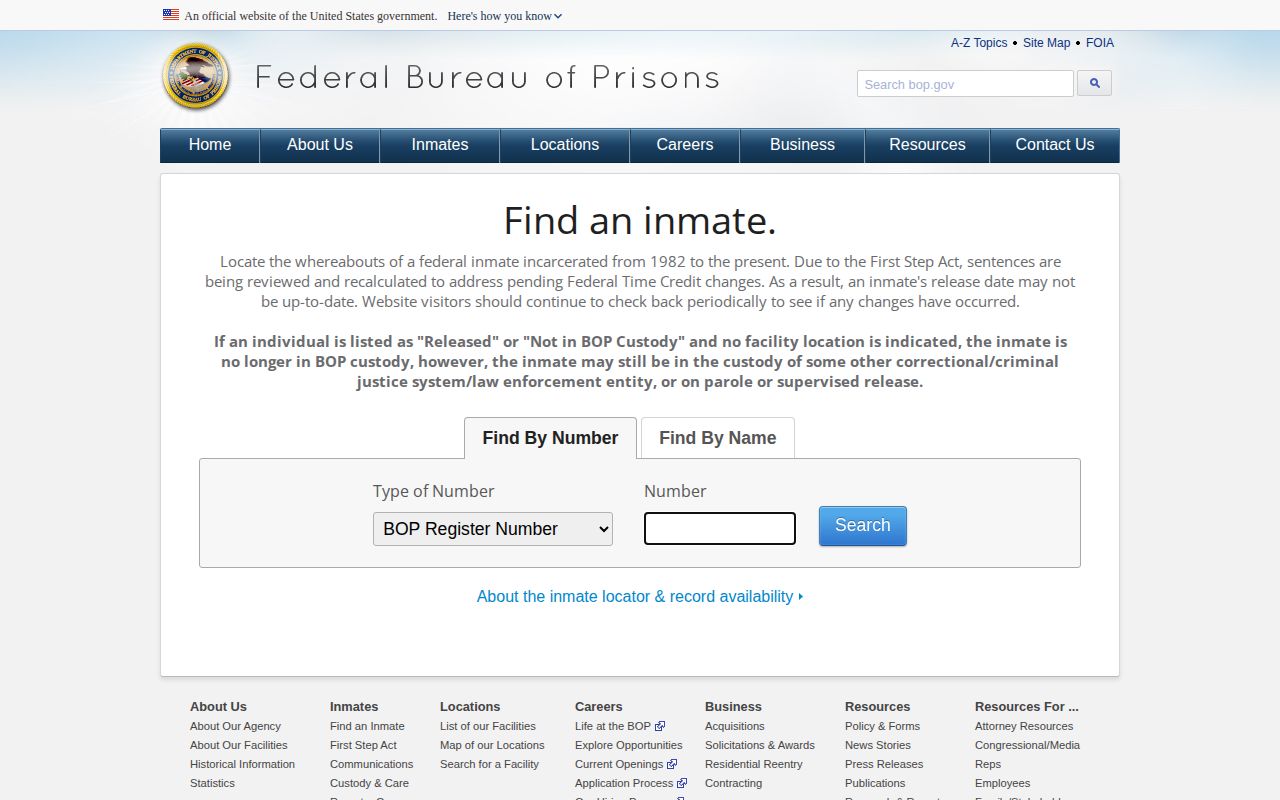
Use that result with the federal docket or release document when a Franklin County matter entered federal custody.
Where Franklin Release Records Appear
The right source follows the custodian. County and state records are not interchangeable, and a live roster is not a historical archive.
| Situation | Start here | What it proves |
|---|---|---|
| Still in Karnes or FCCC II | FCSO current-inmate search | Present county-jail booking and location |
| Past county-jail exit | FCSO release or movement record | Actual departure, type, and public destination fields |
| Court authority | Municipal or Common Pleas docket | Bond, dismissal, sentence, or conveyance order |
| Ohio prison release | ODRC Offender Search | State status, date labels, and APA supervision |
| Federal sentence | BOP locator and federal court | BOP custody status and federal legal record |
| ICE custody | ICE detainee locator | Covered ICE custody or recent release result, with limits |
Franklin County Release Facilities
Franklin County’s two active Sheriff jails share one current-inmate search and inmate-information line. Karnes at Fisher Road replaced the old downtown Main Jail in 2022. FCCC II remains at Jackson Pike. An internal move between those campuses is not release. Older requests may need the names Franklin County Corrections Center I, Main Jail, or the South Front Street address.
- James A. Karnes Corrections Center holds county detainees and locally sentenced people.
- Franklin County Corrections Center II is the other active FCSO jail and uses the same roster.
- The Franklin County Community Based Correctional Facility is a residential prison-diversion program; departure may leave community control in place.
- Franklin Medical Center is an ODRC state medical prison, so state search and records control its releases.
Franklin County does not contain a standalone BOP institution in the research set. Federal defendants may be housed locally before transfer, while people committed to ODRC can serve sentences elsewhere in Ohio. The last known building should never override the agency that held custody at the time of release.